
Dreaming of twinkling lights, mulled wine, and laughter with your favorite travel companions? A girls’ trip to Germany’s Christmas markets is the perfect way to embrace the holiday spirit. Here’s how to plan a magical festive getaway — with tips, an itinerary, and advice from my own trip.
The hustle and bustle of the holiday season usually has me veering more towards Grinch than Santa, but I’ve discovered the perfect way to capture the holiday spirit and bring back my childlike joy…Christmas Markets!! Between the scent of roasted chestnuts, the twinkling lights of the slowly-spinning Christmas pyramids, the warm gluhwein, the charming handmade crafts and the delicious treats, you really do need to be a Grinch to not enjoy an authentic Christmas Market. And what better way to experience Germany’s Christmas Markets than on a girls’ trip.
A couple of years ago I decided it was finally time to experience Germany’s famous markets for myself. I reached out to a friend who I knew loved Christmas markets as much as I did. She’d even done a Christmas market river cruise before. We started comparing notes — the ease of a river cruise versus the freedom of a road trip, how many markets we could realistically fit in, and which towns felt the most festive.
In the end, we decided on a road trip that combined both worlds: the big-city sparkle of Frankfurt and Stuttgart, and the storybook charm of smaller towns like Rüdesheim and Ravenna Gorge. What followed was a week of holiday magic and lasting memories.
If you’ve ever dreamed of wandering through Germany’s Christmas markets with your favorite travel companions, here’s everything you need to know — from timing and logistics to a sample itinerary and packing tips.

Planning a Girls’ Trip to the Christmas Markets
Traveling with friends can be so fun— but it also takes a little coordination to make sure everyone gets what they want from the trip. Before you start booking, talk through these details to set yourselves up for success:
When to Go and What to Expect
Most Christmas markets in Germany open in late November and run until just before Christmas Eve. If you go in early December, you’ll find smaller crowds and plenty of festive energy. Closer to Christmas, the markets are busier and the hotels are pricier, especially in larger cities.
It is going to be chilly, with temperatures typically hovering in the 30s or 40s Fahrenheit, and you might even see some snow. I won’t lie, hand warmers and toe warmers are a must, but it just makes you appreciate the mulled wine even more.
Days are short, with sunset around 4:30 PM, which means you’ll have plenty of time to enjoy the markets after dark when the lights truly shine. Some markets are only open in the evenings or only on the weekends, so you will want to check the times and opening dates before you book.
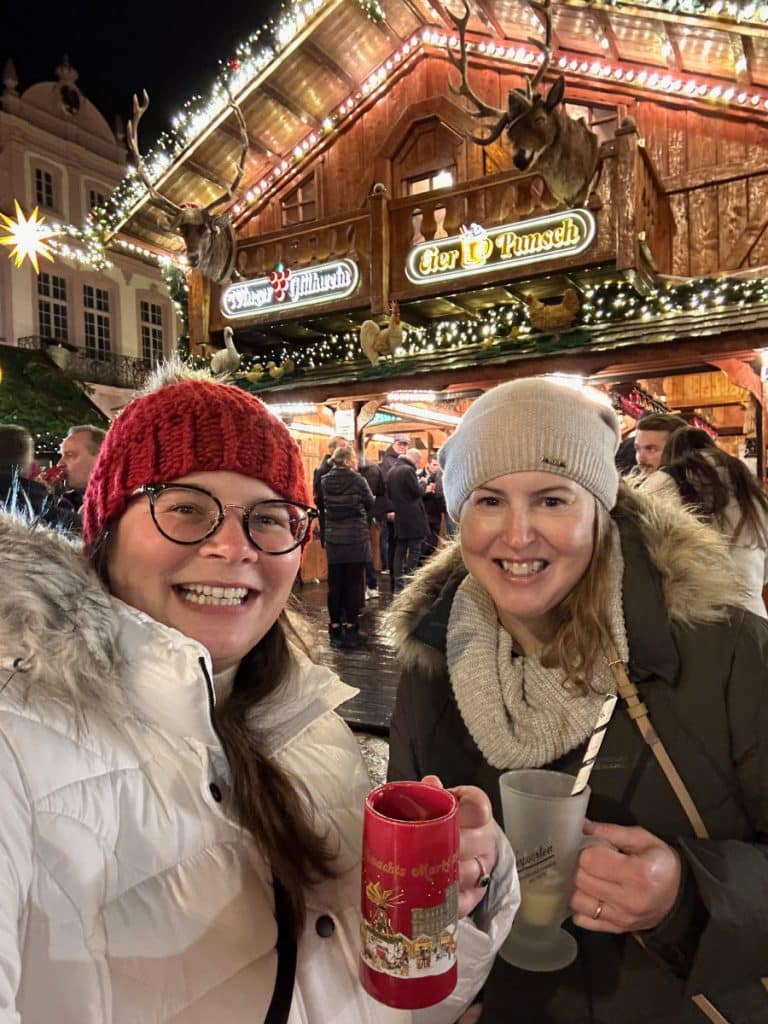
Book Early — Really Early
Hotels in the Old Towns (Aldstadts) closest to the Christmas markets sell out months in advance. Even smaller towns fill quickly because many Germans also travel within their own country to visit these markets.
Christmas Markets river cruises can sell out up to a year in advance so start planning now for next year! If you’re planning a group trip, start coordinating as early as possible, especially if you want to stay near each market square or have specific room configurations (keep in mind that not many European hotels have two queens and only some have two twins.)
Who’s Coming
Start by deciding how many people you want in your group. For Christmas markets, I think two to four is ideal — small enough to stay flexible, big enough for plenty of laughs. If you’re doing a road trip, make sure at least one other person is comfortable driving in Europe. German roads are excellent, but parking in small towns can be tricky.
For larger groups, a river cruise can be an ideal option as there are fewer logistics to coordinate. If you book early enough, there is plenty of space. Everyone can eat together (or not) and transportation to and from the Christmas markets is included.
Rooming Arrangements
Are you sharing rooms or each getting your own? If you’re close friends and on the same sleep schedule, sharing can be fun (and budget-friendly). But if someone snores or likes to get up early, consider separate rooms. For river cruises, I can help you find cabins that work for pairs or solo travelers — some even have dedicated single staterooms.
How Many Markets to Visit
It’s tempting to fit in as many towns as possible, but you don’t want to overdo it. My friend Amanda and I visited something like a dozen Christmas Markets in a 10-day trip. You would think they would get old and repetitive after a while, but honestly I loved it. Each market has its own personality — some bustling and grand, others intimate and local. But I also recognize that it is more than most people would want to tackle.
For a week-long trip, aim for about four to five stops and take some day trips by train so that you don’t need to change hotels every night (another reason why the Christmas Markets river cruise is so appealing!) This gives you time to explore during the day and soak up the evening atmosphere without feeling rushed.
Beyond the Markets
While the markets are the main event, it’s worth adding a few extras to round out your trip. Maybe that’s a castle visit, a wine tasting along the Rhine, a day at a spa, or a detour through the Black Forest. Germany in winter has so much more to offer than twinkling lights.
Budgeting & Splitting Costs
Group trips work best when everyone’s clear on expectations. Discuss budgets for accommodations, meals, and shopping before you go. Apps like Splitwise make it easy to keep things fair and avoid awkward money conversations later.

How to Visit the German Christmas Markets
There are three main ways to explore the markets — and each has its own appeal depending on your travel style and how much you want to move around.
1. River Cruise: Effortless & Immersive
If you want to visit multiple markets without the hassle of changing hotels, a Christmas market river cruise is hard to beat. You unpack once, and each morning your floating boutique hotel docks in a new festive town. You might wake up in Cologne one day and find yourself in Strasbourg or Rüdesheim the next.
Meals, transportation, and many excursions are included, so all you have to do is show up and enjoy. If that sounds like your kind of trip, I can help you compare itineraries and ships to find the right one for your group — whether you want to focus on the Rhine, the Danube, or a blend of both.
Do you need help planning your trip? If you are feeling overwhelmed and don’t have the time or resources to wade through tons of information and question your decisions, I help clients plan a custom itinerary, tailored to your interests and travel style. Learn more about my Travel Advisor and trip planning services.
2. Train Travel: Convenient & Scenic
Germany’s rail system is excellent, making it easy to visit major cities and many smaller towns without renting a car. For a girls’ trip, this can be a fun and low-stress way to travel — no need to worry about driving or parking, and you can chat and relax between stops.
The tradeoff is flexibility. Trains work best if you’re sticking to larger markets like Frankfurt, Cologne, Munich, or Nuremberg. You’ll need to keep an eye on schedules, but it’s an eco-friendly and scenic way to experience Germany in winter.
3. Road Trip: Flexible & Adventurous
That’s the option we chose. We wanted to mix well-known markets with some smaller, more local ones. With a car, we could wander off the main route and linger wherever we felt the magic. Best of all we had somewhere to store our luggage if we stopped along the way and we didn’t need to lug our suitcases along the snow-covered cobblestone streets from the train station.
Driving in Germany in December is straightforward, but plan for shorter daylight hours and occasional snow. Rent a car with winter tires, and make sure to ask your hotel about parking ahead of time — many historic centers have pedestrian-only zones.
Our Germany Christmas Market Itinerary
We started our journey in Frankfurt, an easy gateway for international flights and a great place to ease into the festive spirit. Over the course of a week, we made a loop through southwestern Germany — a mix of big cities, smaller villages, and one unforgettable market deep in the forest.
Day 1: Frankfurt

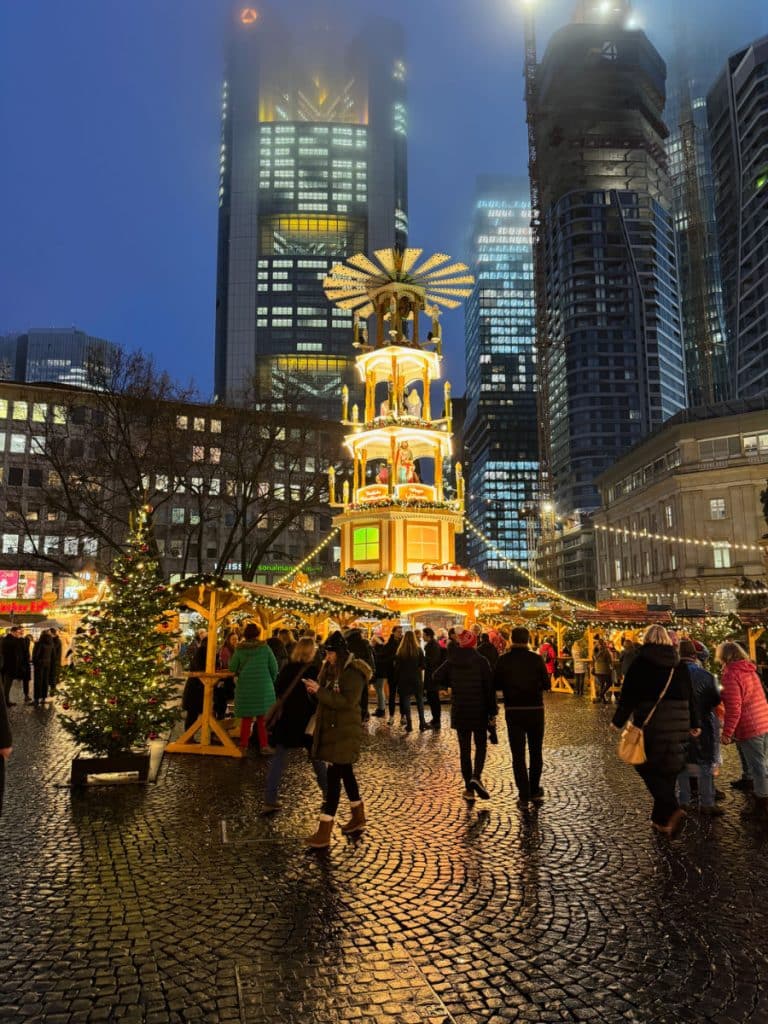
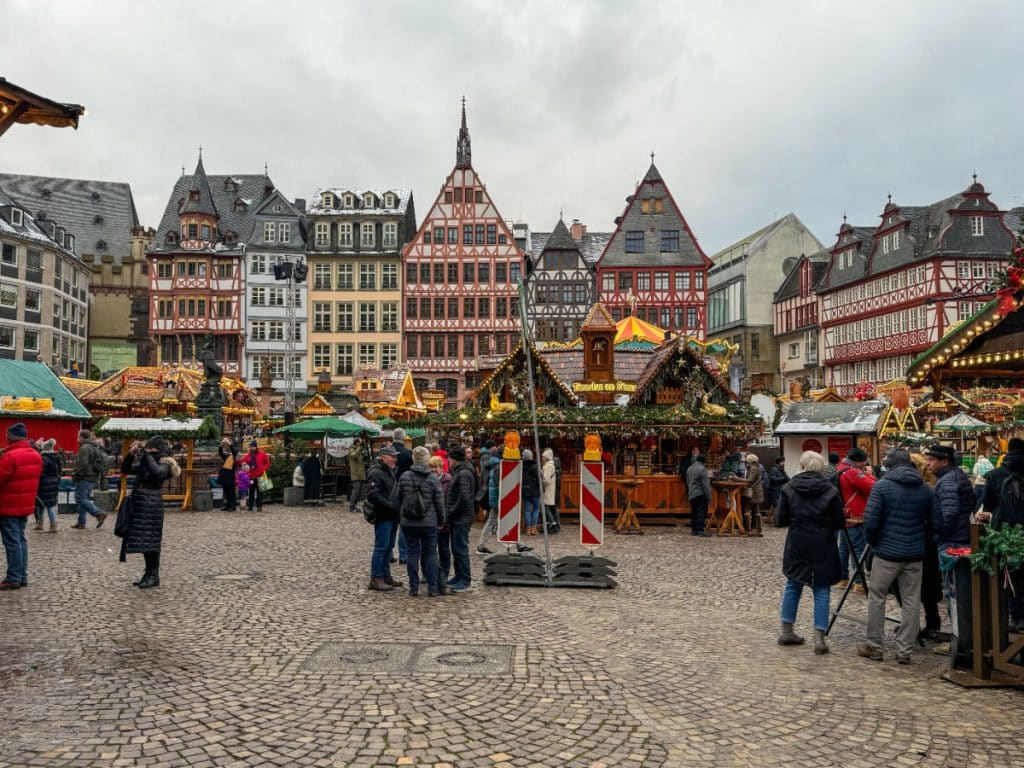
After landing, we checked into a boutique hotel near the Römerberg, where the city’s main Christmas market sprawls across cobblestone squares framed by half-timbered houses. Frankfurt’s market is one of Germany’s oldest, and it feels wonderfully traditional — carousels, wooden stalls, and the smell of almonds roasting in sugar.
I spent my first evening sipping glühwein and people-watching as a brass band played carols in front of the giant Christmas tree. It was the perfect way to start the trip.
Day 2: Rüdesheim am Rhein
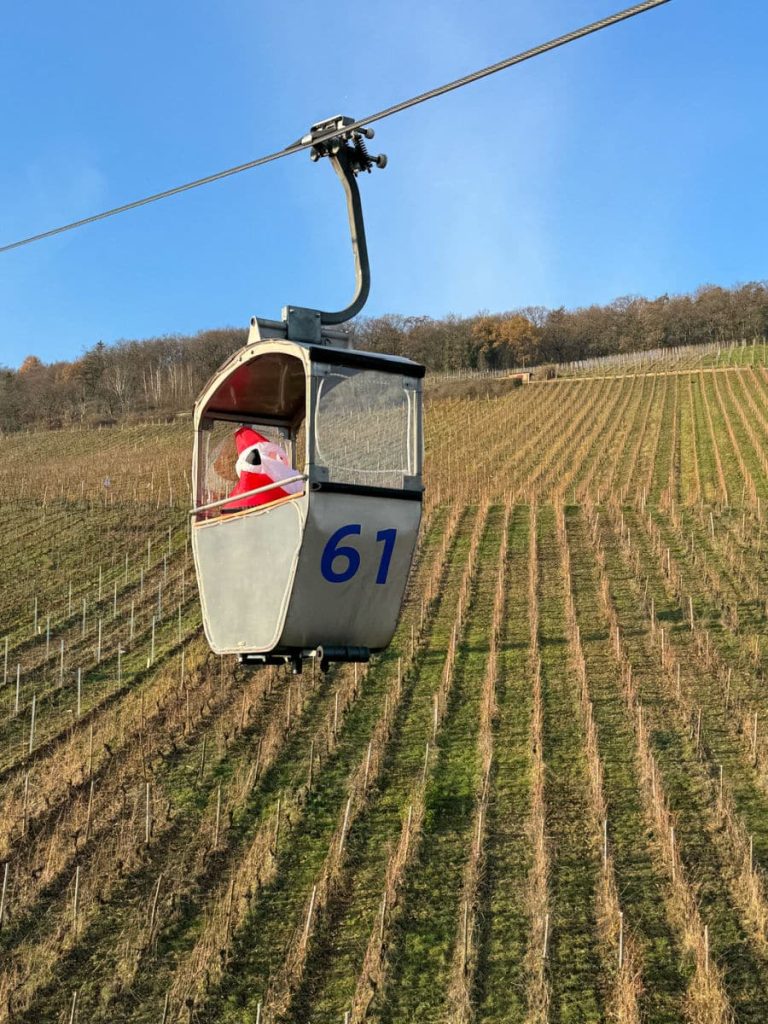

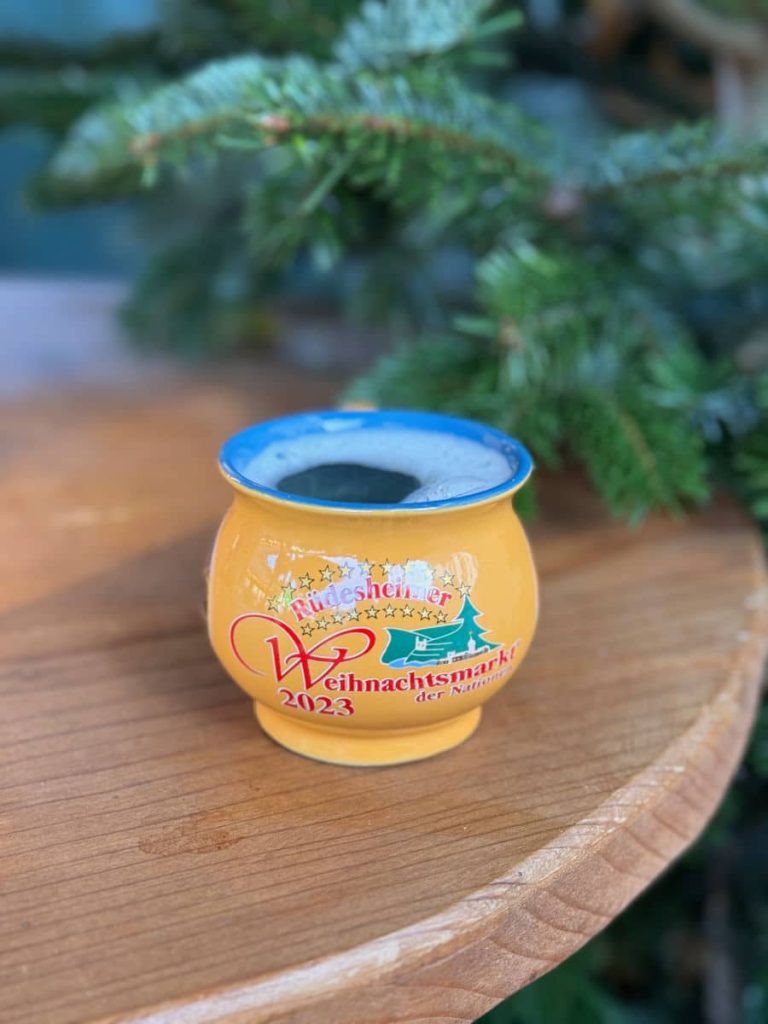
The next morning, we picked up our rental car and drove about an hour west to Rüdesheim, a charming wine town on the Rhine River. Its “Christmas Market of Nations” features holiday traditions from more than 20 countries — and while it’s small, it’s packed with character.
I took the cable car up to the Niederwald Monument for panoramic views over the vineyards and river. The town is very crowded with river cruise passengers during the day, but if you stay overnight, you can enjoy the markets when they are more peaceful.
Where to stay: I loved the charming rooms at the centrally-located Breuer’s Rüdesheimer Schloss. They even have free parking, which can be really hard to find in these smaller towns. Otherwise, drive to Trier and spend two nights there.
Day 3: Trier


From Rüdesheim, we headed southwest to Trier — Germany’s oldest city. Its market unfolds in front of the cathedral, surrounded by Roman ruins and elegant baroque buildings.
This was one of my favorites: the perfect mix of history and holiday spirit. We browsed stalls selling handmade pottery, candles, and ornaments, and then stopped for a local specialty — eierpunsch, which is a warm egg liqueur-based drink.
The food and craft stalls were also impressive, with one of my favorite käsewurst sausages of the trip and some delicious poffertjes, which are small Dutch pancakes (which we also saw in Amsterdam).
Where to stay: I loved my stay at the Romantik Hotel Zur Glocke, right in the Old Town. This is one of my favorite boutique hotels, with beautifully-designed, luxury rooms, an amazing location, and even complimentary breakfast all for a very affordable rate. The only downside is that there isn’t parking on-site, but you can use a paid lot nearby.
Day 4-5: Freiburg im Breisgau

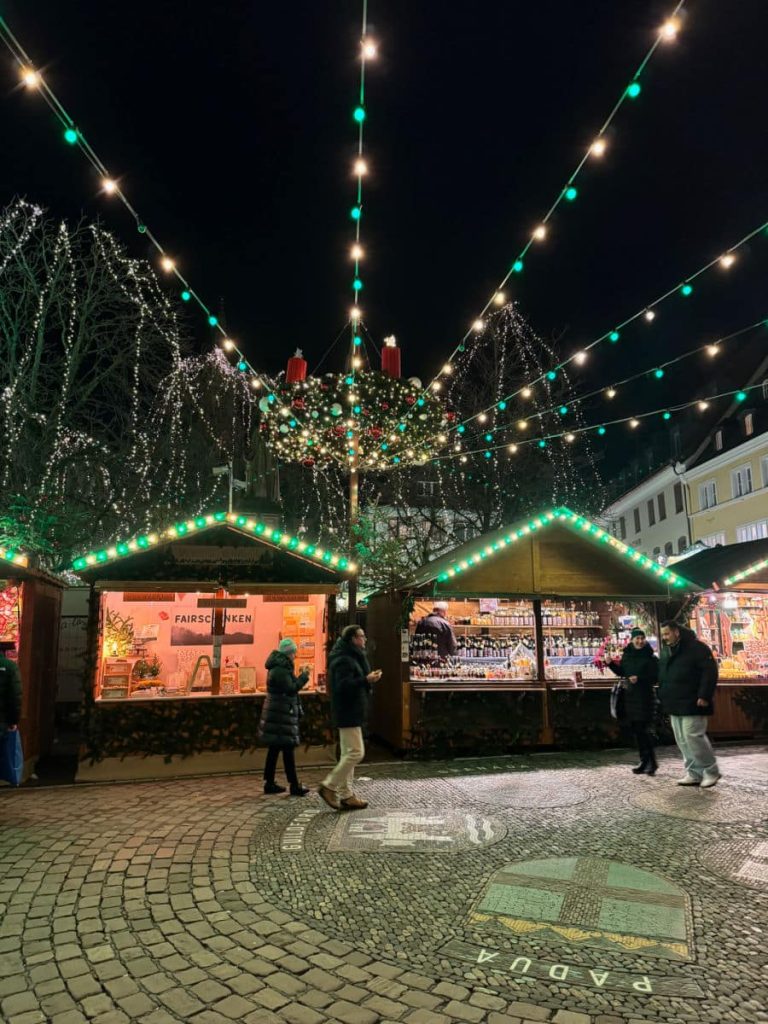

Next, we drove into the Black Forest region to the university town of Freiburg. Your drive will likely take you through a bit of the Alsace region of France, and if you have the extra time, you can add in a day in Strasbourg and/or Colmar, or a short stop in Strasbourg on the way.
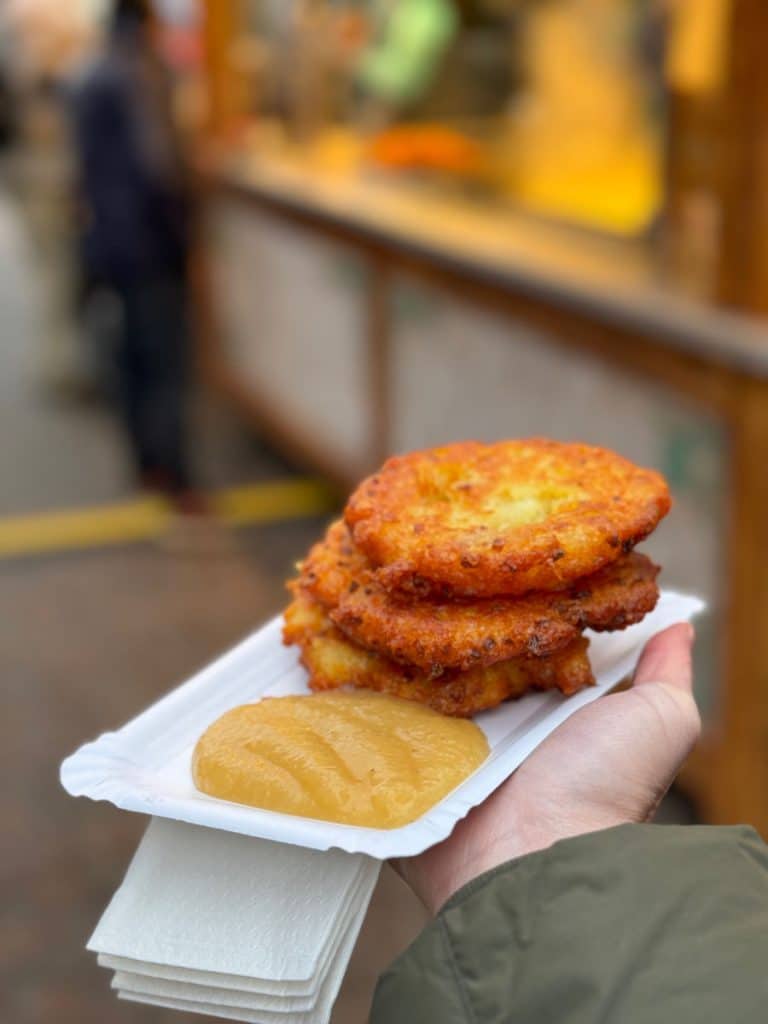
Freiburg is vibrant but not as hectic as some of the larger cities like Stuttgart or Frankfurt. I had some delicious Christmas market foods in Freiburg including käsewurst (cheese-stuffed bratwurst), a potato tornado, and kaiserschmarrn (torn sweet pancakes served with vanilla sauce). This really felt like a market for locals, with products including colorful local cheeses and beautiful miniature houses for those looking to to create a Christmas village under their tree..
Where to stay: If possible, I would look to stay at the Colombi Hotel. Whatever you do, try to arrange for parking in advance because it is scarce in the city center (hence all the bicycles.) If you need to stay a bit further from the city center, the tram system is convenient for getting around.
Day 5: Ravenna Gorge
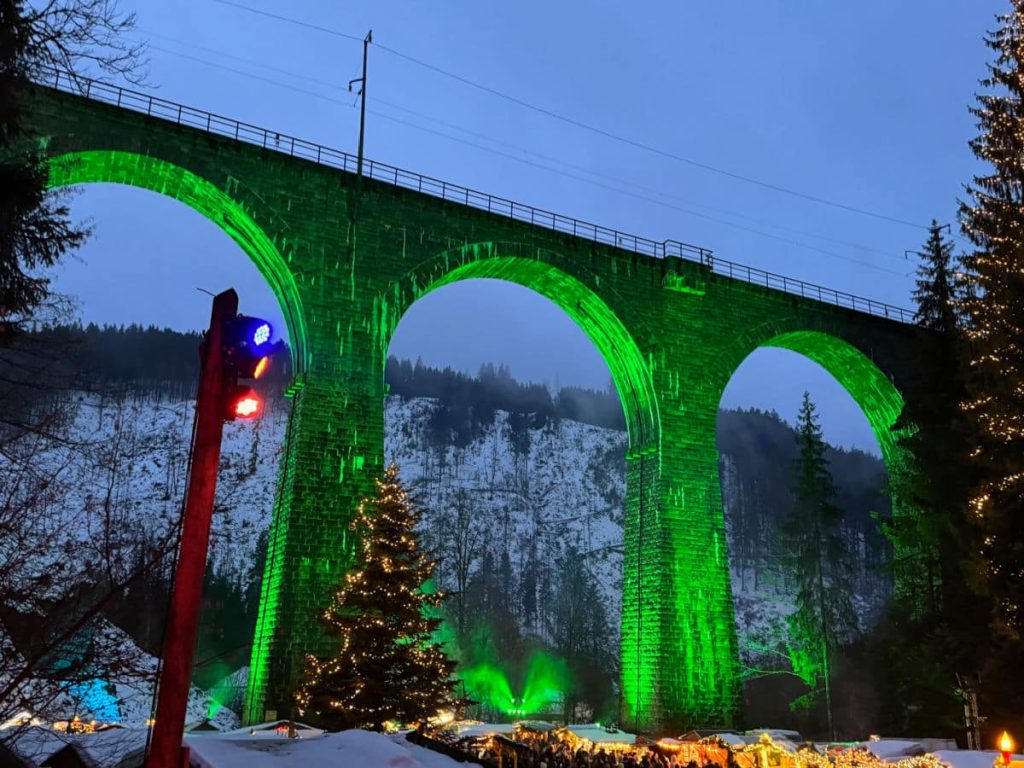
This stop was pure magic and accessible from Freiburg so get to spend a night without switching hotels. The Ravenna Gorge Christmas Market is tucked under a towering stone viaduct in a forest clearing. At night, colored spotlights illuminate the arches above.
It’s smaller than other markets, but unforgettable — the kind of place that makes you feel like you’ve stepped into a fairy tale. It does require some advance planning though!! This is the only market on this trip that requires tickets, and they go fast. In addition, the market is only open on Fridays, Saturdays, and Sundays — so hopefully your dates will work out! If not, you could skip this day and shorten your trip, or spend a night or two in France instead.
You need to sign up for the newsletter to learn the exact date and time that tickets go on sale and jump online on that day (the earlier the better) to get the prime time slots. You also need to book a parking spot or plan to take the train and have a shuttle reservation instead.
Day 6-7: Stuttgart


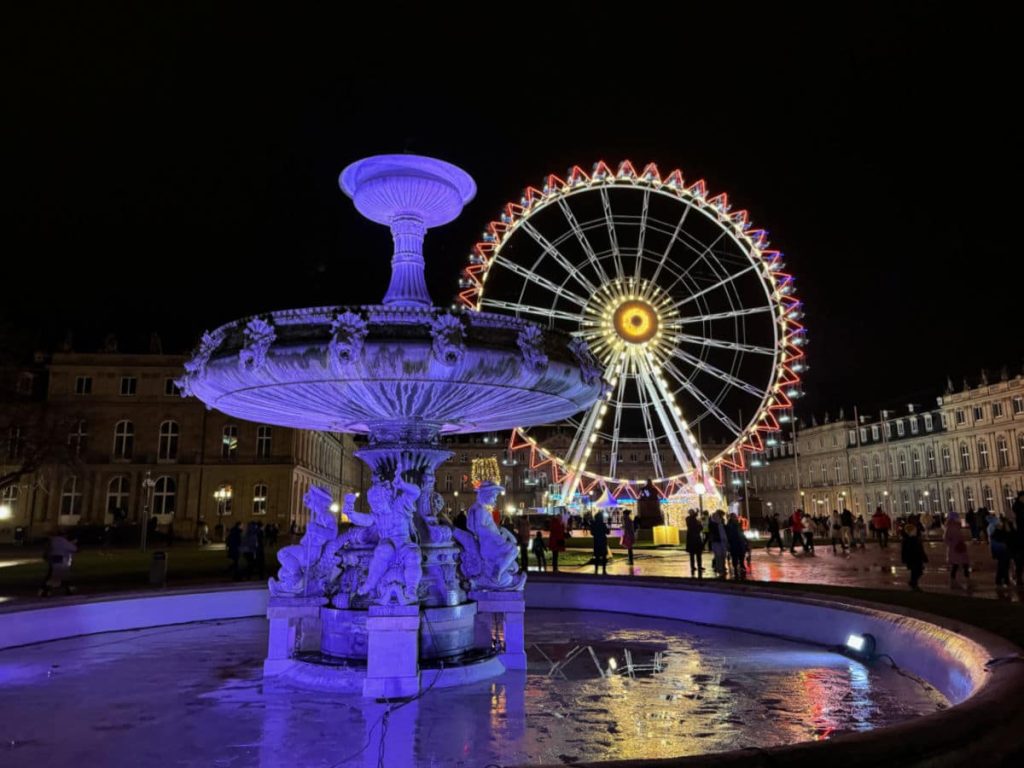
After a few days of smaller towns, we were ready for something livelier. Stuttgart’s Christmas market is one of Germany’s oldest, with hundreds of elaborately decorated stalls spread across the city center.
In addition to the typical Christmas Market fare, you will find some unique features including an antique market, Finnish market, and a live nativity scene. Schlossplatz is where you will find most of the action with stunning light displays, along with children’s rides such as a carousel, a small Ferris wheel, and a real mini steam train. Schlossplatz also hosts a large Ferris Wheel, a small roller rink, daily live concerts, and an eco-market, featuring local foods and vegetarian options.
Stuttgart is also home to the Porsche Museum, Mercedes-Benz Museum, the Stiftskirche, and other museums around Schlossplatz. You may also want to check out Stuttgart’s public library if you are book lovers.
Where to stay: It is best to stay near the city center or close to the train station, although the U-Bahn trains make it pretty easy to get around the city. Finding an affordable hotel, especially one that offers parking, can be a challenge. I stayed closer to the train station, to make it easy to take day trips, at the Jaz in the City Stuttgart hotel. Just make sure you also book a parking space in advance or plan on parking at the train station.
Day 7: ESSLINGEN AND LUDWIGSBURG


From Stuttgart, it is easy to take a day trip by train to visit two other Christmas Markets. Esslingen is just 20 minutes by train and home to a large Medieval Christmas market that is nothing like anything else you have experienced thus far.
The Medieval Market has hand-operated rides like a merry-go-round and a mini carousel, along with a variety of games such as archery, bowling, and other games of skill. It is great fun but can also get very crowded, so it is best to go in the morning before it gets too jammed.
After visiting Esslingen, you can take the train back to Stuttgart and hop another train at the station for a 20-minute ride to Ludwigsburg. The Ludwigsburg Baroque Christmas Market was another one of my favorite Christmas markets on this trip because it is meant for and attended by locals.
I saw a larger variety of authentic handicrafts in Ludwigsburg than in any of the other Christmas Markets I visited in Germany. With excellent food and drink options too, this market is such a joy!
Day 8: Heidelberg & Return to Frankfurt


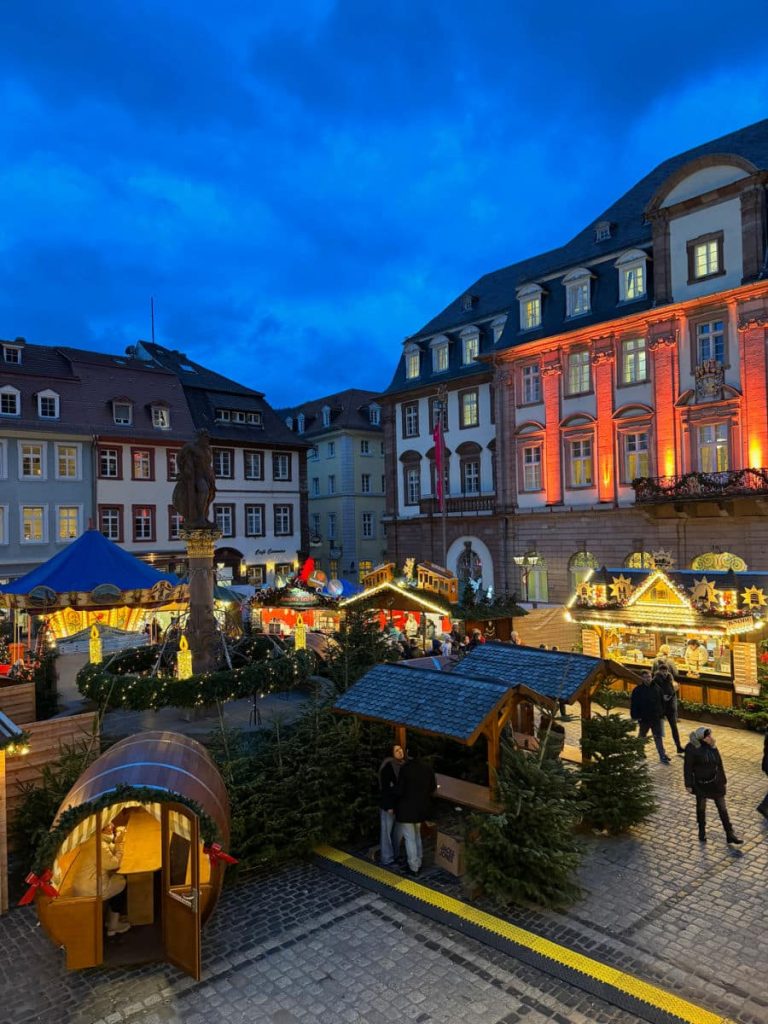
Our final stop was Heidelberg. Heidelberg is also a university town, full of shops and restaurants. While in town, you will also want to visit the Heidelberg Castle. Set on a hill, you can access the castle via funicular and either take a guided tour or just get a ticket to explore the grounds on your own.
The old town glows under the shadow of the castle, and the market stretches along the main pedestrian street with stalls full of ornaments, candles, and sweets. In addition to the standard food and craft stalls, you will want to see the small ice skating rink and the giant wine barrels that serve as cozy drinking spots.
Where to stay: If you choose to stay overnight, Hotel Villa Marstall is located in Old Town, within a short walking distance to the Christmas Markets, shops, and restaurants. The rooms are small but quaint and affordable. There isn’t any parking on-site, but there is a pay garage just a few blocks away. Otherwise, you can drive up to Frankfurt and spend the night at the Sheraton Frankfurt Airport Hotel. It is a very short walk to the terminal or the train station.
What to Pack for a German Christmas Market Trip
Packing for Germany in December is all about balancing warmth and comfort. You’ll be outside a lot, so think practical layers and waterproof shoes. It can be warm indoors so be prepared to put on and take off layers throughout the day.

Clothing
- Insulated coat (ideally water-resistant)
- Warm sweaters and thermal tops
- Comfortable jeans or pants (fleece-lined if you get cold easily)
- Waterproof boots with good traction
- Hat, gloves, and scarf (you’ll live in them!)
- A nicer outfit for dinner or evening drinks
Accessories
- Crossbody bag that zips securely
- Portable charger and plug adapter (Type F)
- Hand and toe warmers (lifesavers!)
- Foldable tote for shopping
- Lip balm and moisturizer
- Reusable water bottle
- Travel umbrella
Souvenir Tips
Many markets serve hot drinks in collectible mugs with a small deposit — you can return them for your refund, but I guarantee you’ll want to keep at least one. I wrapped mine in bubble wrap and tucked it into my carry-on.
If you’ve been dreaming of your own festive escape — whether that’s an easy river cruise, a scenic train journey, or a self-drive adventure — I can help you plan it. From choosing the right itinerary to booking hotels, transfers, and special experiences, I’ll make sure your girls’ trip is stress-free, stylish, and full of holiday cheer.
Ready to start planning your Christmas market adventure? Let’s design a magical winter getaway that combines cozy charm, festive markets, and time to reconnect with your favorite travel companions — all the joy, none of the hassle.

Tamara Gruber is an award-winning travel writer and the founder of Your Time to Fly. With more than a decade of professional writing experience across two travel publications and hundreds of destination guides, she specializes in crafting practical, detailed itineraries that help travelers explore the world with confidence. Her work reflects years of on-the-ground research across the globe. Tamara is a member of SATW and serves on the Board of Directors of the Family Travel Association.
