
A Delicious Journey Through Bologna, Parma, Modena, Verona, and the Vineyards
When people ask why Italy is my favorite country, one of the top reasons I always give is quite simply…the food. There are so many amazing food regions in Italy, from the pizza of Napoli, the carbonara of Rome, the lemon-infused seafood of the Amalfi Coast, and the truffle-laden dishes of Piedmont (one of my favorite places.) But your Italian food journey is not complete without spending time in Italy’s Food Valley.
Located in the northern Emilia-Romagna region, Italy’s Food Valley is all about the Parmigiano Reggiano cheese, Prosciutto di Parma, traditional balsamic vinegar of Modena, and sparkling red Lambrusco wine. Nearby Bologna’s claims to fame include its eponymous Bolognese sauce, mortadella, and tortellini in brodo (a delicious broth.)
You can easily spend three to five days eating and walking your way through Bologna and Parma, but I recommend making a triangle and adding a day or two in another great food city…Verona. This City of Love isn’t just for star-crossed lovers, food lovers will also appreciate the rich flavor of risotto Amarone or gnocchi with gorgonzola, while adventurous eaters could try pastissada de caval, a stew made from horse meat.
In this trip you will not only indulge in some of Italy’s most iconic products, but you will also have time to explore walkable historic cities, student-filled piazzas, world-class opera houses, and wine regions producing Amarone, Valpolicella, and Soave. This is a destination that rewards both curiosity and appetite.
This itinerary draws from my time in Bologna, Parma, and Verona—three cities that each bring something different to the table. This guide helps you savor the best of the region. Want help planning your trip to Italy? I’d love to put together your dream itinerary. Find out more about my trip planning services.
Day 1: Bologna – Highlights, Markets, and Culinary Traditions
Start your trip in Bologna, which is connected by flights from many cities in Europe or by train from Rome, Venice, Florence, or Milan. Bologna is energetic, scholarly (it’s a university city), and frankly, a little chaotic. With more than 25 miles of porticoes in the historic center, it’s a city best explored on foot.
Note: This post contains affiliate links. If you click a link and make a purchase, I may receive a small commission at no cost to you.
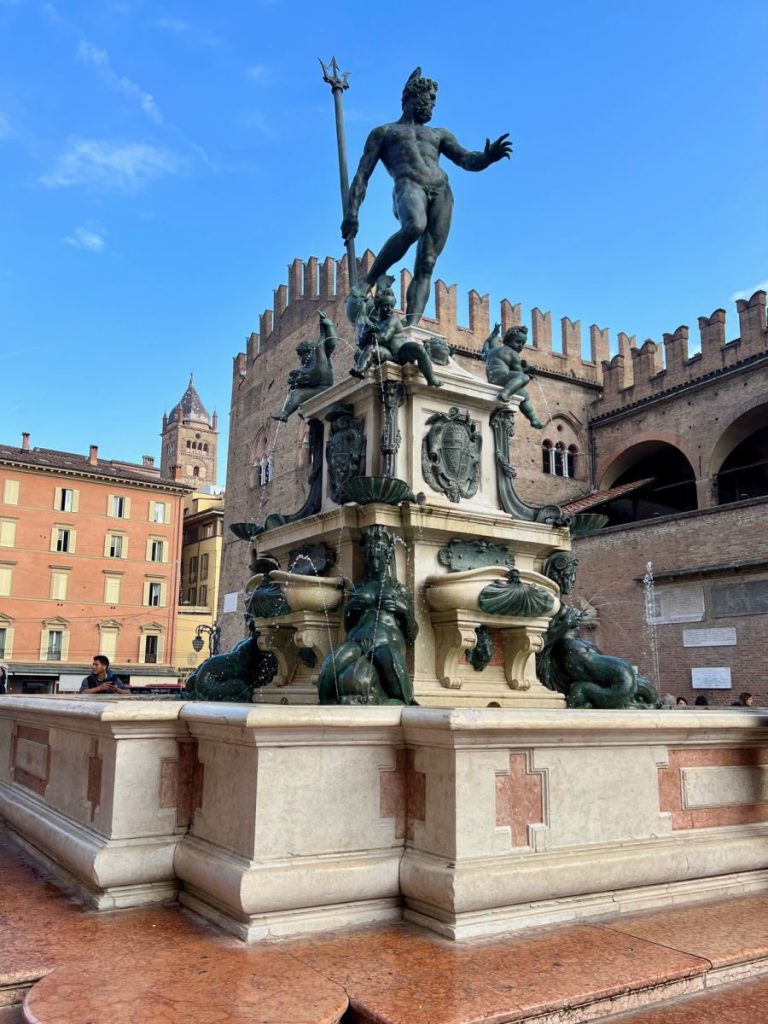
Exploration of the city of Bologna almost always starts in Piazza Maggiore, the beating heart of the city. This is where you will find the Basilica di San Petronio, Palazzo del Podesta, and the famous Neptune’s Fountain. You can explore on your own, but I’d highly recommend booking a guided tour of the city highlights.
From Piazza Maggiore it is five-minute walk to the Asinelli Twin Towers. These structures were built by wealthy Bolognese families to demonstrate their wealth, which is why you have two right next to each other — trying to compete to be the tallest. Today these towers lean slightly and aren’t able to sustain an elevator. So if you want to climb the Asinelli tower, which was built between 1109 and 1119, you will need to climb 498 steps to the top. Just be sure to book your tickets a few days in advance!
It is only another five-minute walk to the complex of the Seven Churches at Basilica di Santo Stefano and Piazza Santo Stefano, one of the prettiest squares in Bologna. The entrance to this complex of churches begins at the Church of the Crucifix (Chiesa del Crocifisso). In between the various buildings you can take a peaceful break in the Pilato Courtyard and medieval cloister.
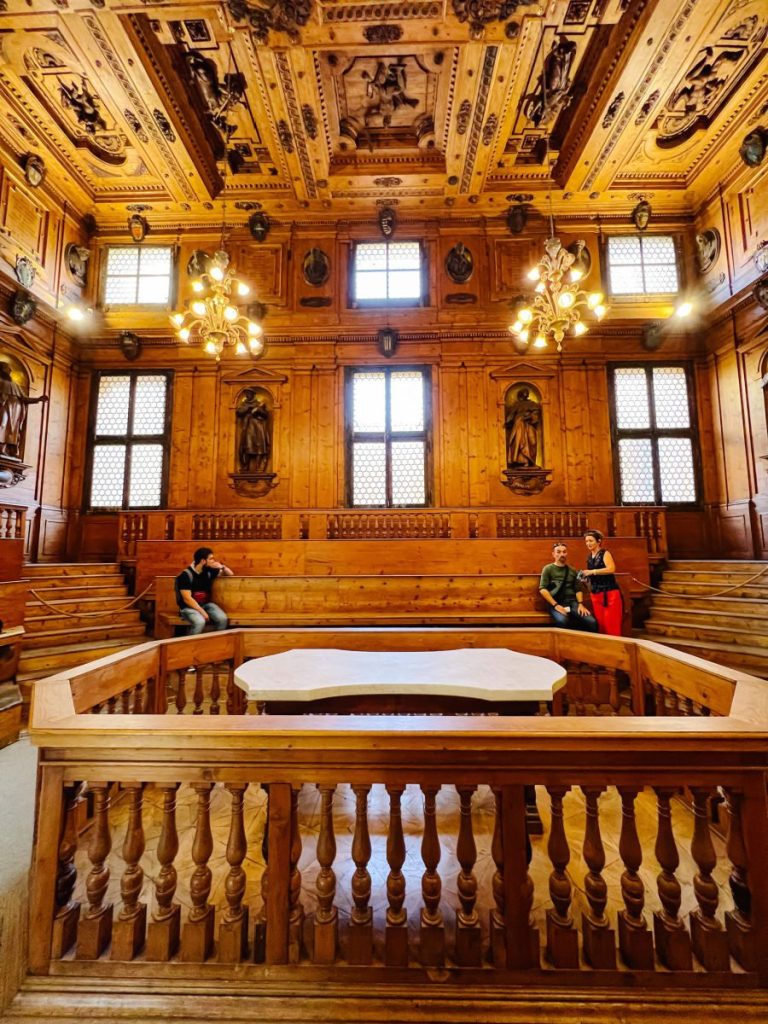
From the Seven Churches it is a seven-minute walk over the Teatro Anatomico. This amphitheater was was designed in 1637 for anatomical lessons and it was built by the Bolognese architect Antonio Paolucci. The walls are made of spruce wood and festooned with statues depicting twelve famous physicians. The ornate wood ceilings are a masterpiece. As gory as the history of the room might be, you will want to take a seat and take time to appreciate the small details.
But not only is this room an architectural marvel, its history, in high contrast with the control of the church and papacy which was decidedly anti-science, was equally fascinating. This is a tiny glimpse into Bologna’s buzzing University Quarter.
You may also want to include a visit to the Bologna’s “secret window” that provides a view of the “Venice of Bologna.” Just keep in mind that these canals in Bologna are sometimes drained to be cleaned during the fall, so your view may not be as pretty as it is at other times of year.
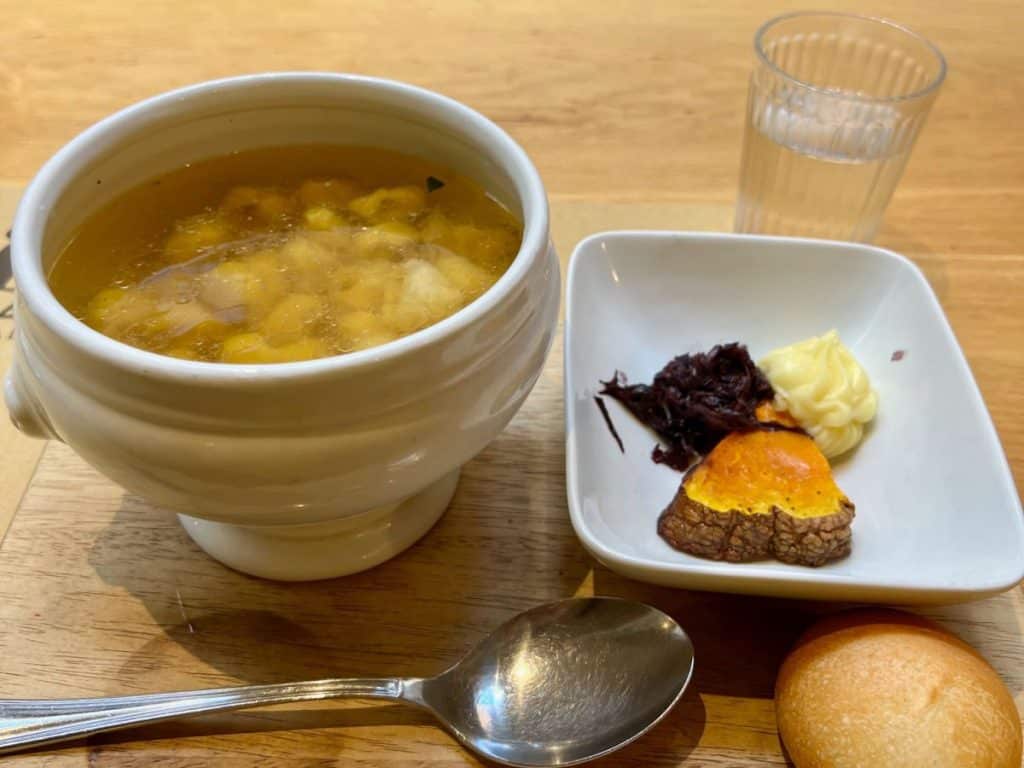
When you get hungry, it is worth the wait for a spot at Sfoglia Rina, but try to go early if you can. The ladies at Sfoglia Rina make tortellini by hand. You can choose fresh pasta to go at the counter (no wait) or sit in the cafe and enjoy a delicious meal. I’d highly recommend the simple dish of tortellini in brodo, which is just the small stuffed pasta in a rich chicken broth that is better than any tortellini soup you have ever had.
After your meal, wander the Quadrilatero and peek into cheese shops and bakeries while wandering past fishmongers and fresh produce stands. You can also spend some time strolling under the porticos shopping in beautiful boutiques.
Day 2: Bologna – Cook with a Local
One of the best ways to enjoy Bologna’s specialties, while also getting to interact with a local is with a cooking class. There are many options, but I wanted to try a cooking class with Cesarine, a network of over 1,500 home cooks across Italy who teach cooking classes using their family recipes in their homes. I met my guide and teacher Paola in Piazza Maggiore. From there we toured the markets, picking up ingredients that we would use during our cooking demo. We then walked to her charming apartment just outside of the historic center.

Over the course of the next couple of hours, I learned to make piadina, a soft Italian flatbread that we later served with cheese and meats that we picked up at the markets as an apertivo. Next, we made the dough for tagliatelle pasta — one of my favorites. After preparing a tiramisu for dessert and taking a break for the apertivo, I learned (or attempted at least) how to roll out the pasta by hand to that perfect, delicate thinness necessary to make the perfect pasta bolognese.
We didn’t make the bolognese meat sauce in the class, since that takes hours to simmer, but Paola did share her own recipe and we used the bolognese that she prepared before I arrived. When everything was prepared, it was time to eat!
If you don’t enjoy cooking, you could try a food tour instead. I recommend a tour with Delicious Bologna. From hidden, small family-owned gourmet stores, to sitting down to share a tasty meal, this four hour tour leaves guests knowledgeable about wine, home-made pasta, pizza, local cured meat, cheese, balsamic vinegar, coffee, and small batch gelato! This gastronomic tour includes hidden spots and interesting historical tidbits.
Day 3: Modena – Balsamic Vinegar & Ferrari

Modena is best known for one of Italy’s most carefully protected culinary treasures: traditional balsamic vinegar, a product so revered that it carries its own designation of origin. Unlike the mass-produced balsamic vinegar found in grocery stores, Aceto Balsamico Tradizionale di Modena DOP is made from nothing more than cooked grape must, then aged for a minimum of 12 years—and often far longer—in a series of wooden barrels called a battery. This type of “liquid gold” can go for well over $50 for a small bottle and is used by the small spoonful, and not dumped onto a tossed salad.
But this area isn’t just about this dark liquid. Maranello’s sleek Ferrari Museum is just down the road, beckoning car enthusiasts.
Start your morning with a visit to a traditional acetaia. Here, rows of small wooden barrels indicate the different stages of aging. For families that produce balsamic vinegar, they often will gift a barrel when a baby is born that they can keep when they (and the vinegar) come of age at 18. The balsamic is transferred from barrel to barrel each year, concentrating slowly over decades. Tasting it by the spoonful is unlike anything you have poured in your typical Italian restaurant back at home. It is silky, thick, and layered with flavor.
After the acetaia, make your way into Modena’s historic center. The Mercato Albinelli is a lively, colorful stop with vegetable stalls, fishmongers, cheesemongers, and ready-made dishes to nibble as you wander. This is a perfect place to graze your way through lunch or pick up local specialties to take home. Modena is also home to some of Italy’s best restaurants, so if you want a Michelin-star experience, this is the day to plan for it.
In the afternoon, head south to Maranello, the beating heart of Ferrari. Even if you’re not a car person, the Ferrari Museum is surprisingly captivating. The exhibits tell the story of Enzo Ferrari, the rise of the Scuderia racing team, and Italy’s long-standing obsession with design and speed. Gleaming cars sit under soft spotlights like sculptures, and the mix of engineering and artistry feels almost reverential.
If you’re feeling bold—and this may be one of those once-in-a-lifetime opportunities—consider signing up for a Ferrari test drive. Several companies near the museum offer short supervised drives through the countryside. Whether you choose the museum, the test drive, or both, ending your day surrounded by this much passion and craftsmanship creates a perfect counterpoint to the quiet patience you saw in the acetaia that morning.
Return to Bologna for dinner or spend the evening in Modena if you prefer a slower pace.
Day 4: Parma – Opera, Art, and French Elegance
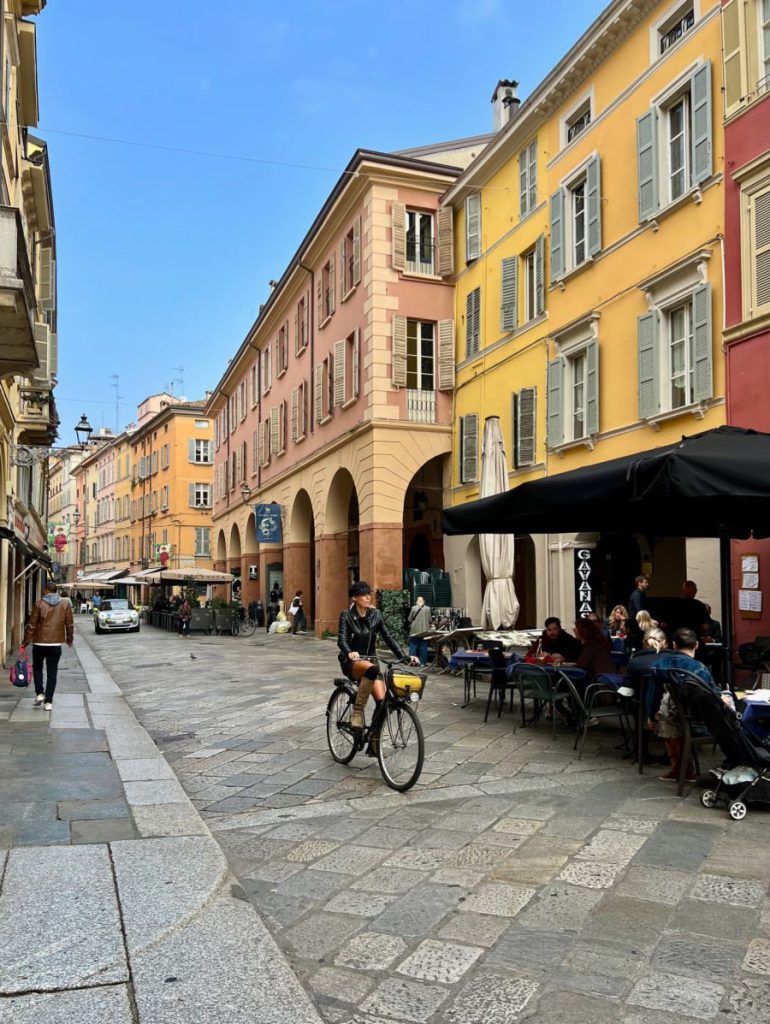
Parma is an easy hop from Bologna—just about an hour by train, with frequent departures that make the journey easy. As soon as you arrive, you begin to notice the differences. While both are university cities, Bologna leans brick-red and medieval while Parma is painted in warm shades of buttery yellow, which comes from the region’s centuries-long ties with France. Parma was once home to the Bourbon-Parma dynasty, and their influence can be seen not just in the color of the buildings but in the graceful neoclassical lines that define many of the city’s landmarks.
But it isn’t just the architecture. Parma is quieter and more elegant than Bologna, making it my clear favorite of the two. I would strongly recommend taking a walking tour to truly appreciate the city.
Start your exploration in Piazza Duomo, where you will find the Cathedral, Baptistery, and Bishop’s Palace. Step inside the Cathedral to see Correggio’s famous fresco overhead.
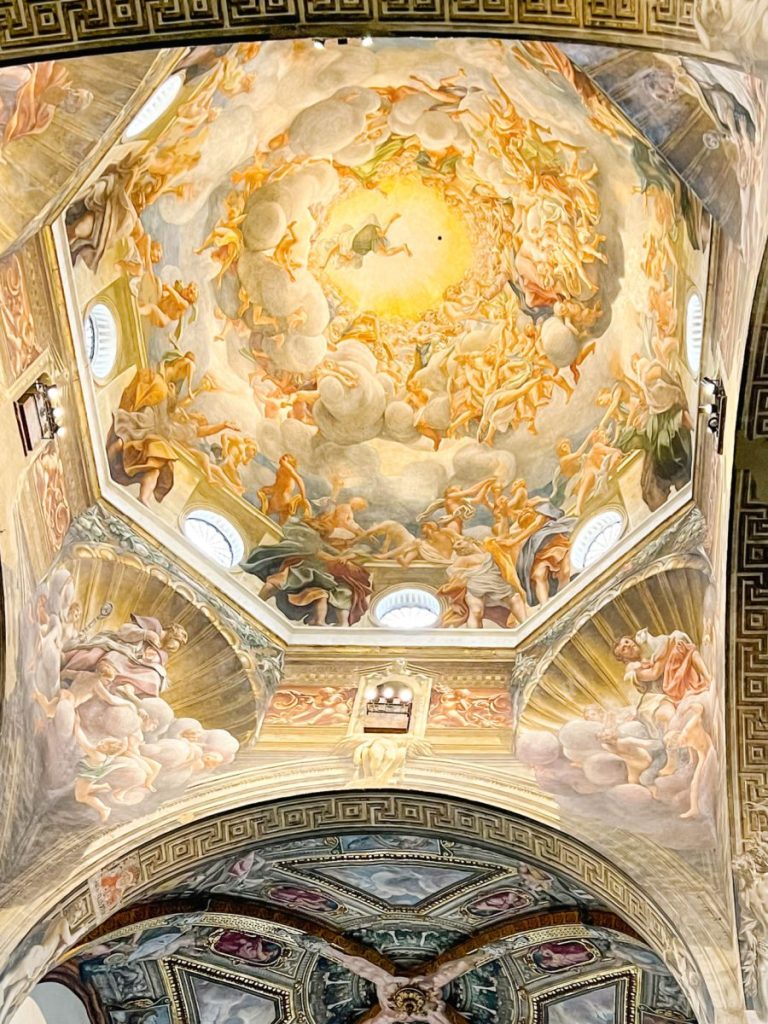
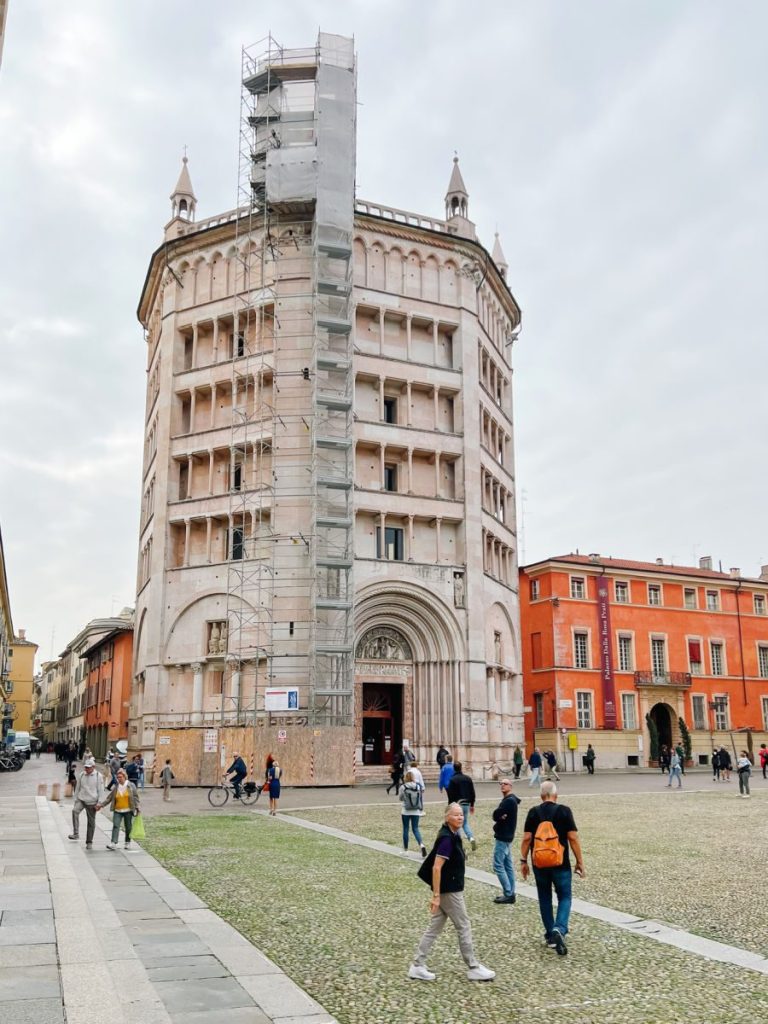

From here, wander toward Teatro Regio, Parma’s renowned opera house. Nearby you will find cafes, bakeries, and gourmet shops that showcase an overwhelming selection of prosciutto, culatello, and Parmigiano Reggiano.
Cross the river into Parco Ducale, one of the city’s prettiest green spaces, with gravel walkways, fountains, and broad stretches of shade. Finish at Piazza della Pace in front of the Palazzo della Pilotta. Dating back to the 1600s, the Palazzo houses a museum complex that includes one of Europe’s richest art collections. The Piazza in front has various monuments and fountains, along with green space where locals and students gather and lounge in the Italian sunshine.
The Palazzo della Pilotta houses four museums, the Parma National Gallery, the Palatine Library, the National Archeological Museum, and the Teatro Farnese, or the Farnese Theater. The Farnese Theater is one of the largest Baroque theaters in Europe and it has seen many grand productions and feats of engineering in its centuries of operation.
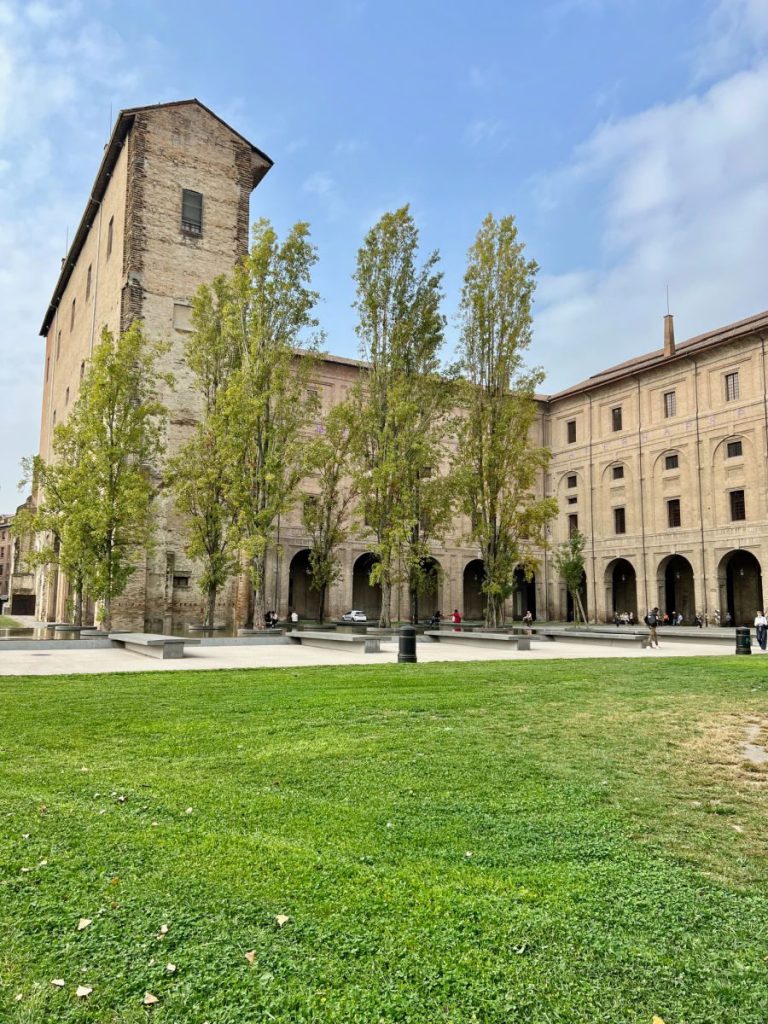
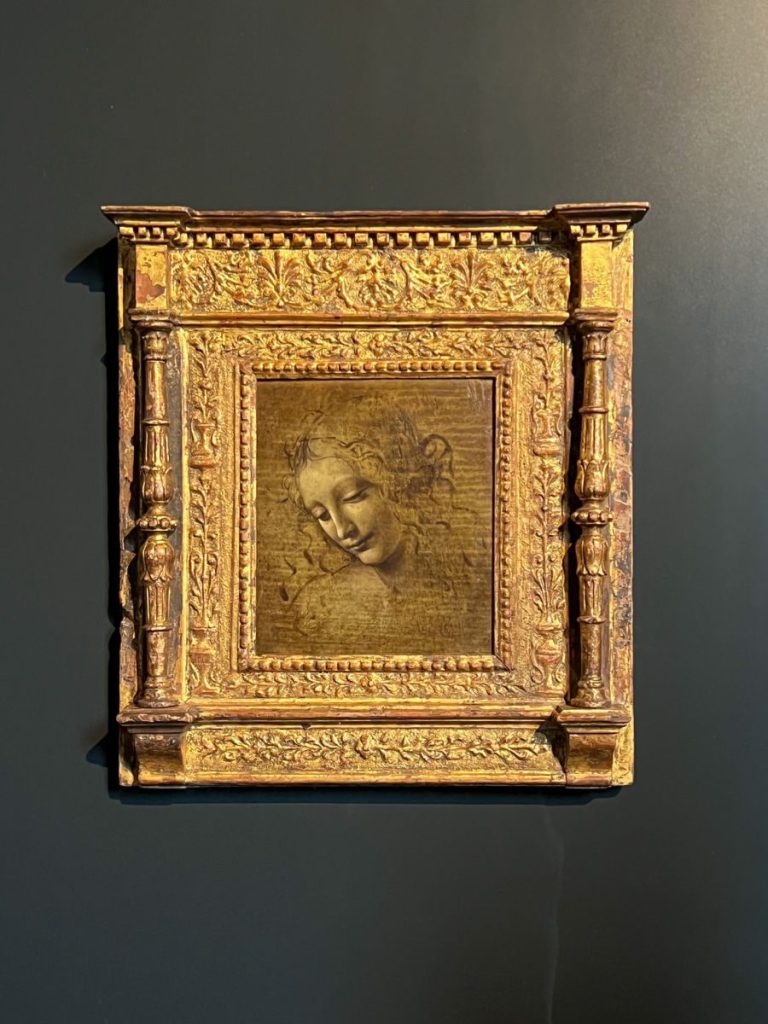
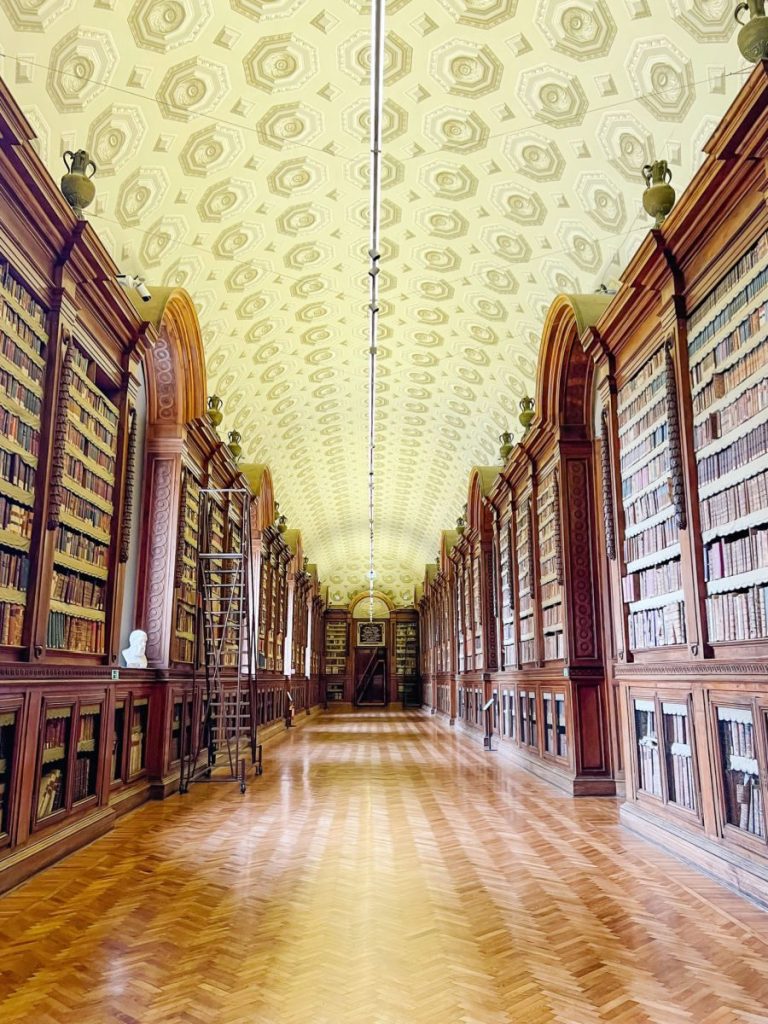
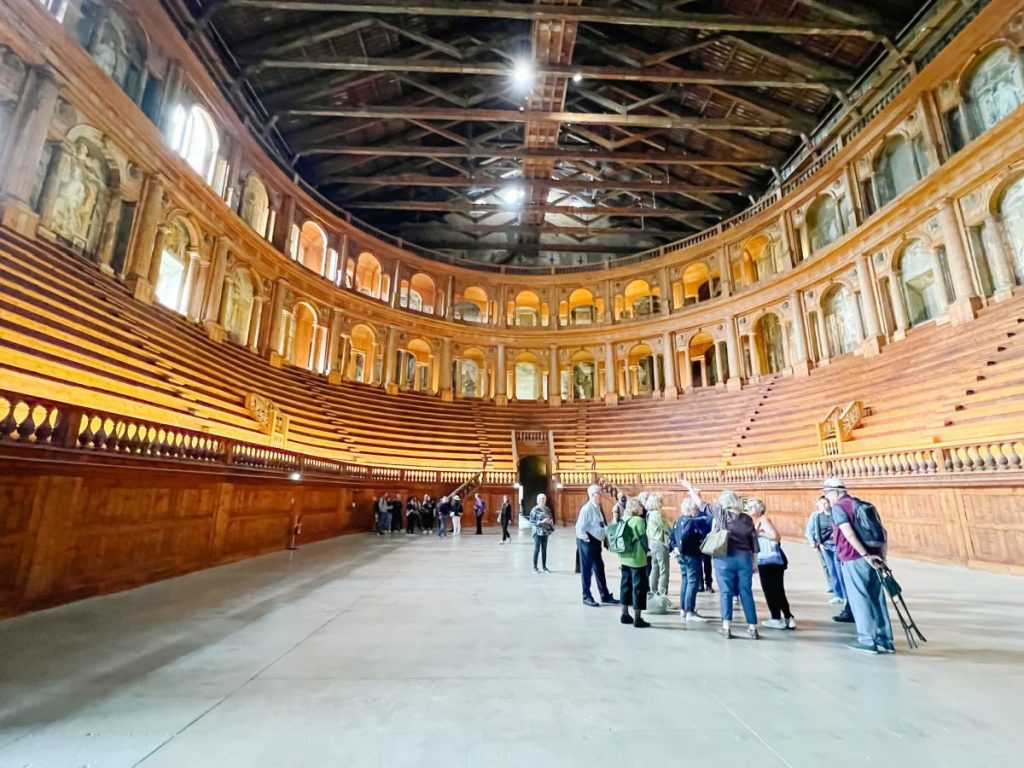
While the theater suffered from great damage during the bombing in World War II, it has been rebuilt in its original style. While not all guided tours enter the museums of Palazzo della Pilotta, don’t miss returning and visiting on your own. The wooden gallery and sculptures are quite stunning in scale and design. If you get a chance to peek behind the stage, you can glimpse how elaborate productions were concocted to shock theatergoers of old with horses and water flooding the stage.
Dinner should be unapologetically local. Order torta fritta paired with an assortment of salumi, then move on to tender tortelli d’erbetta or another regional pasta.
Day 5: The Food Valley Producers


A day among the producers is the beating heart of this itinerary, and it’s one of the most memorable experiences you’ll have in Italy. Today is not about sightseeing as much as witnessing craftsmanship—methods passed down through generations, each rooted deeply in the region’s identity.
Your morning begins at a Parmigiano Reggiano dairy, often before 9 a.m., when the day’s cheesemaking is in full swing. Copper vats bubble gently as curds form and watching the cheesemakers maneuver the cheese with rhythm and strength is mesmerizing. You are then walked through each step of the process, but the true highlight is the aging room —a vast space lined floor to ceiling with wheels stacked neatly on wooden shelves. I honestly got butterflies in my stomach it was just so cool to experience it in real life (as you can tell, I like cheese.) And of course, your tour will end with a tasting of cheese of various ages. Just remember, you can’t bring anything back to the States unless it is vacuum-sealed.
Next, visit a Prosciutto di Parma producer, where you’ll follow the process from salted pork legs to beautifully aged prosciutto. The curing rooms can be a bit stinky…definitely not a place for vegetarians, but I did gain an appreciation for what makes Prosciutto di Parma worthy of distinction. Plus, you will not leave without tasting some samples.
If you didn’t visit a balsamic vinegar producer in Modena, add a stop at a traditional acetaia to round out your knowledge of the region’s culinary icons.
Most tours include a delicious lunch—think handmade pasta, generous plates of cured meats, and local wines poured freely. By the end, you’ll understand why Emilia-Romagna is often considered Italy’s greatest food region. It isn’t just about the flavors; it’s the reverence for the process.
Return to Parma for a quiet evening because you probably won’t want to look at any more food after all that you consumed during the day!
Day 6: Fair Verona
If you have the time to extend your stay in the region, I would add a couple of days in Verona. To make transportation easier, you could actually fly into Venice and start your trip in Verona, then make your way by train to Bologna and Parma. But either way, you can get to Verona by car or train.
While many people visit Verona on a day trip from Venice, I encourage you to stop and stay a while. In a short time, it quickly became one of my favorite cities in Italy. The city center is compact and charming with clean streets that are easy to navigate. It can get crowded but nothing like Venice or Florence, except perhaps in the courtyard of Juliet’s house at midday. I visited on my own and felt totally safe as a solo female traveler, even at night.
I would definitely recommend taking this city highlights tour with LivTours.
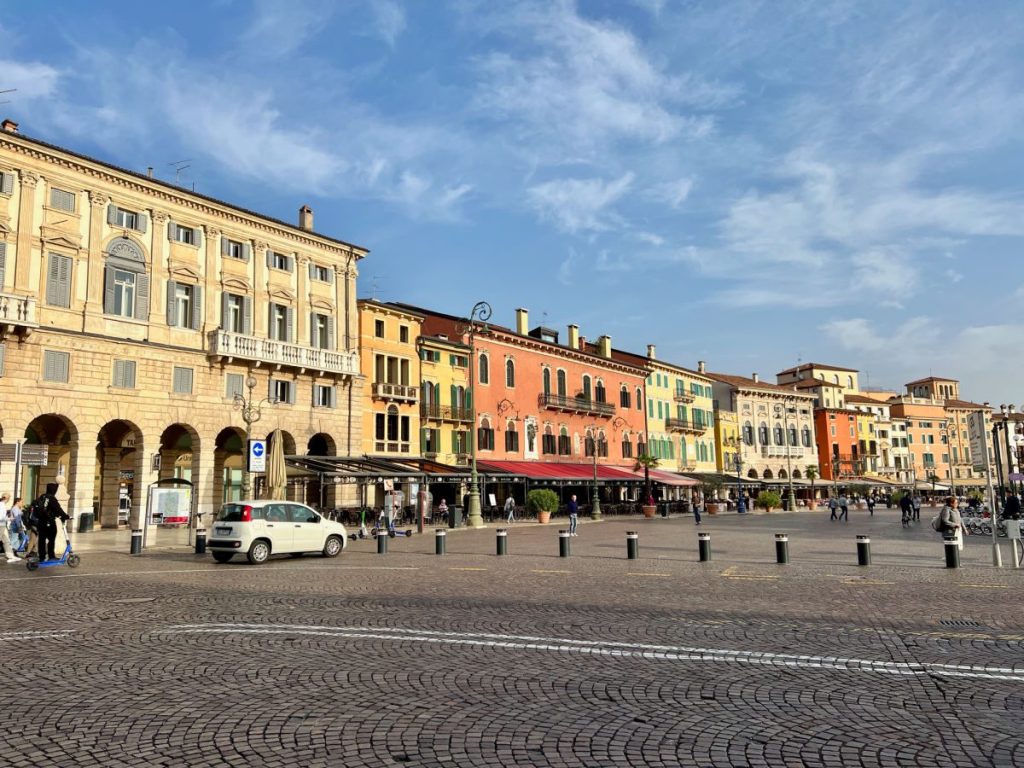
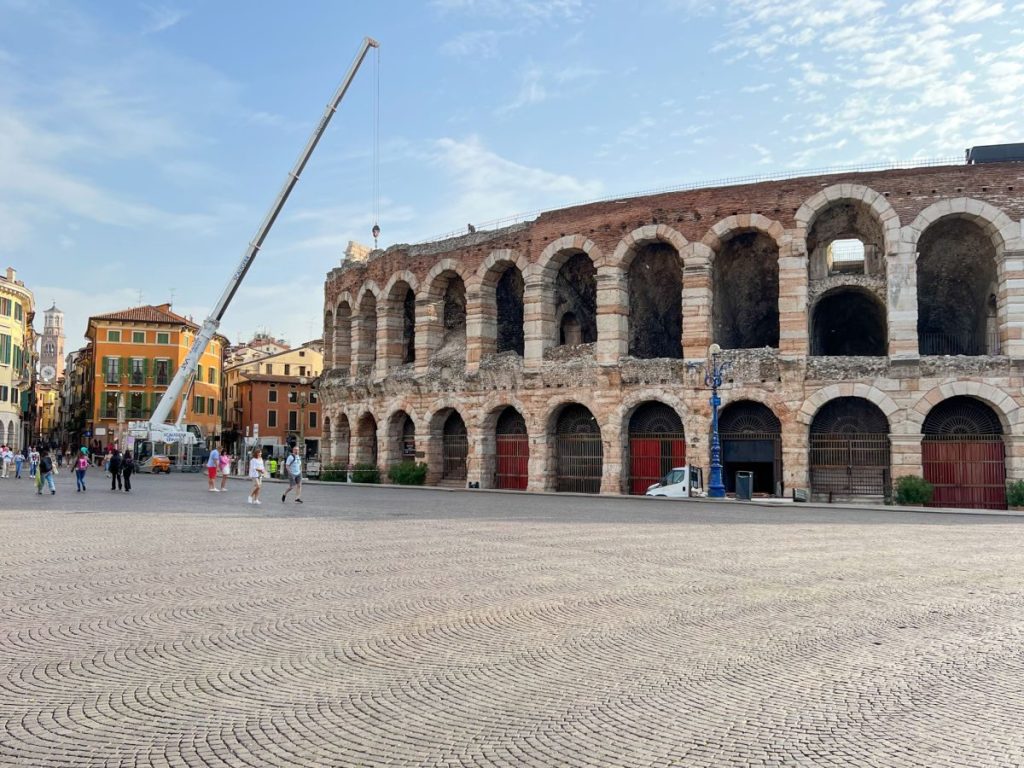
Start off exploring the Centro Storico (historic center) of Verona in Piazza Bra. This picturesque square is the hub of the city. In the center of the square, you will find the Brà Fountain and a monument to Vittoria Emanuele II, the first king of Italy. Surrounding the piazza you will find the city gate, the Arena di Verona Roman amphitheater, the Verona Philharmonic Theatre (home to the Verona Opera Festival), and the City Hall.
The Arena di Verona is a Roman Amphitheater built in the first half of the 1st century B.C., making it older (although smaller) than the famous Roman Colosseum. The Arena was built between the end of the empire of Augustus and the empire of Claudius to host gladiator shows, struggles with wild animals, and other events that were popular at the time.
From the Piazza Bra and the Arena, I would recommend walking up the pedestrian street of Via Giuseppe Mazzini toward Piazza delle Erbe. This tiled street is lined with designer boutiques and is a main shopping area in Verona.
Make your way to Juliet’s House before the day trippers arrive, as it is one of the most famous and visited attractions in Verona. Casa di Giulietta is located in a medieval palace in Verona off Via Cappello, where the Dal Cappello family probably lived since the 13th century. Legend has identified it as the birthplace of Giulietta Capuleti, protagonist, along with the beloved Romeo Montecchi, of the famous Shakespearean tragedy, Romeo and Juliet.
The balcony where we can imagine Juliet pining over Romeo is actually a reconstruction using marble remains from the fourteenth century. In the courtyard, there is a bronze statue of Juliet, made by Nereo Costantini. You will notice that her right breast has been rubbed to a sheen by visitors wishing for good luck in love.

Your next stop will be Piazza Delle Erbe (Herbs Square), the oldest piazza in Verona which was the center of commerce, social, and economic life for centuries. Today, there is a market every Monday consisting mainly of souvenirs so the market itself isn’t the attraction, but the buildings around the square are.
In Piazza Delle Erbe you will find the Madonna Verona Fountain. There is also a row of small, narrow but tall buildings on one end that were previously part of the Jewish Ghetto, which was disbanded by Napoleon. At the other end are a series of columns with lions at the top that resemble those in St. Mark’s Square in Venice. Many of the buildings around the square are still decorated with beautiful frescoes that date back centuries. Looming over the square is the Torre del Lamberti.
For a great view of the Piazza, climb (or purchase a ticket to ride the elevator) to the top of the Torre dei Lamberti. Built in 1172 at the behest of the Lamberti family, the bell tower was added in 1295 with two Rengo bells. It later collapsed after a lightning strike and was rebuilt and completed in 1463, with the clock added in 1798. You may want to time your visit to the top of the hour in hopes of being at the top when the bells are rung.

If you follow an archway through the Piazza Delle Erbe, past the Torre dei Lamberti, you will reach another beautiful, and quieter square, Piazza dei Signori. Surrounded by beautiful buildings and cafes, the highlight of this square is the central statue of writer and hometown favorite Dante Alighieri.
If you look closely around this area, you may also find some small carved faces or medallions with open slots. These were actually once mail slots that were used for townspeople to anonymously tattle on those that were committing crimes. Each was set up for a different type of infraction. Kind of fascinating!
Just off the Piazza dei Signore, you will find another courtyard in front of the Palazzo Della Ragione, now home to a modern art gallery. The Mercato Vecchio courtyard is surrounded by a portico with arches supported by rustic ashlar pillars, with stripes of alternating colors of brick and tuff stone.
The main attraction is the Scala Della Ragione, which is a beautiful staircase built from red Veronese marble that makes a beautiful photo backdrop.

Located just a short walk from Piazza Delle Erbe and steps from the Adige River near the Ponte Piedra, the Chiesa di Santa Anastasia (Church of Anastasia) is a Dominican church with Gothic architecture that was built in the late 13th century on an older church. The largest religious building in Verona, this church has a majestic apse and a high bell tower all made from red brick.
The facade was never completed, but inside there are many beautiful chapels with a large collection of paintings by famous painters from Verona such as Girolamo dai Libri and Altichiero. St Anastasia’s most famous work of art is the fresco by Pisanello representing St George freeing the Princess, considered a masterpiece of gothic painting. It decorates the arch of the Pellegrini Chapel.
The Verona Cathedral is located near Anastasia and it is easy to visit both within a short time, especially if you get the pass for all of Verona’s churches. If you are limited in time, you can skip this one as it isn’t as impressive as the other two churches that I recommend.

Of all the churches in Verona, my favorite was Chiesa di San Fermo (although I didn’t get to the Basilica di San Zeno.) While it is a bit more off-the-beaten-path on the banks of the river Adige, near the Porta dei Leoni, the church was built in the 5th century. It is dedicated to the Saints and martyrs, Fermo and Rustico. There is a lower church, but the draw is the upper church, which was completed in 1261.
There are many beautiful frescoes in Chiesa di San Fermo, but what I really loved was the carved wooden ceiling. It is painted with the busts of 416 saints in the arches with vibes of a Nordic grand hall and is an architectural masterpiece.
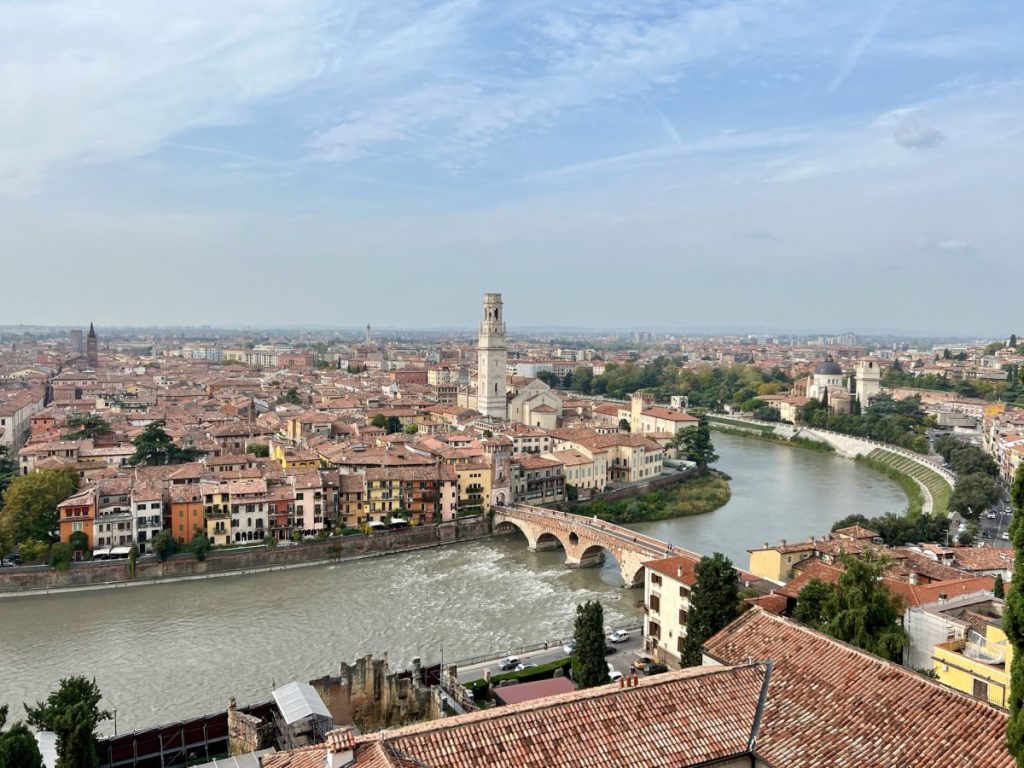
If you are up for a walk, cross the Ponte Piedra, a stone arch bridge built by the Romans in 100 B.C., across the Adige River. On the other side, you can see the Roman Theatre of Verona (Teatro Romano di Verona), which was built towards the end of the 1st century B.C., at the foot of the Hill of St. Peter and overlooking the Adige River.
There is also a great view of the city from the panoramic viewpoint at Piazzale Castel San Pietro. There are two ways to get there, you can take the Funicular or climb up. To reach the funicular station, go to the left after crossing the Ponte Pietra towards via Santo Stefano and the departure station is on the right.
While you are in Verona, make sure to try the local specialties, especially the Risotto Amarone. Two restaurants that I would highly recommend are:
Osteria da Ugo at Lungadige Cangrande 8, 37126, Verona: this osteria is a bit more upscale but still quite friendly and welcoming, especially when I went for lunch. I stuffed myself with a starter and a primi dish and wish I had a second stomach to fit even more because the food was outstanding. I started with the Piatto Lessino, which consisted of polenta with grilled mushrooms topped with asiago cheese wrapped in crispy broiled speck ham. I could have gone home right there but I had already ordered a second course of gnocchi made from polenta with a gorgonzola sauce. I’m not even typically a gorgonzola fan but it was just the right balance for the gnocchi.
Taverna di Via Stella at Via Stella, 5c, 37121 Verona: this small taverna has a wide selection of the meats mentioned above, but they also make an amazing Risotto Amarone, a Veronese specialty. This rich dish is made with at least half a bottle of pricey Amarone wine, so a minimum order of two people is required. That put me in a bit of a pickle as a solo traveler that really wanted to try this dish so I did what any foodie would do and ordered for two — one to eat and one to go and heat up in my hotel room the next day. I’ve since tried to recreate this dish at home but didn’t quite hit the mark so a return trip to Verona is needed just to eat this succulent risotto.
Day 7: Wine Country

After a week of exploring cities and learning about food, your final day unfolds among vineyards just outside Verona. Here, rolling hills, stone villages, and sunlit terraces create a peaceful backdrop for wine tasting.
Head first into Valpolicella on a wine tasting tour, a region best known for Amarone. Many wineries begin tastings with lighter Valpolicella Classico or Ripasso before guiding you through their Amarone—a powerful, elegant wine made from grapes that have been partially dried to concentrate their flavors. The winemaking method, called appassimento, is fascinating to learn about and offers a satisfying link to the region’s agricultural traditions.
If white wine is more your style, continue into Soave, a medieval hill town surrounded by vineyards. The Garganega-based wines here are crisp, structured, and beautifully balanced—the kind of wine you’ll want to take home. The village itself is worth exploring, with cobbled streets, stone walls, and views from the castle above town.
Whether you visit one region or both, take your time today. Enjoy a long lunch, soak in the scenery, and reflect on the craftsmanship you’ve witnessed all week. It’s a gentle, rewarding way to end your journey before returning to Verona for your final night in Italy.
Alternatively, you could take a day trip to Lake Garda for a change of pace. Sirmione is a charming medieval village located on Lake Garda, which is popular with British, German, Italian, and American tourists.
I visited Lake Garda after spending a few days on Lake Como and I have to say, I actually prefer Lake Garda. The aqua blue water is just stunning and the town’s cobblestone streets and shops draped in bouganvilla offer instant charm. In addition to taking a boat cruise and exploring town, you can also tour the lakeside Scaligero Castle.
Do you need help planning your trip? If you are feeling overwhelmed and don’t have the time or resources to wade through tons of information and question your decisions, I help clients plan a custom itinerary, tailored to your interests and travel style. Learn more about my Travel Advisor and trip planning services.
A week in Italy’s Food Valley is a satisfying blend of food, culture, and sensory discovery. You’ll walk Bologna’s historic porticoes, watch cheesemakers lift curds from copper vats, stroll Parma’s elegant squares, taste vinegar aged for decades, and—if you choose—even slide behind the wheel of a Ferrari. It’s a journey grounded in tradition yet full of surprises, and one you’ll look back on with both appetite and affection.

Tamara Gruber is an award-winning travel writer and the founder of Your Time to Fly. With more than a decade of professional writing experience across two travel publications and hundreds of destination guides, she specializes in crafting practical, detailed itineraries that help travelers explore the world with confidence. Her work reflects years of on-the-ground research across the globe. Tamara is a member of SATW and serves on the Board of Directors of the Family Travel Association.
